February 23, 2026
The Next Evolution of Premium Travel Insurance
Delivering continuity, care, and high touch healthcare support when travellers need it most.
Delivering continuity, care, and high touch healthcare support when travellers need it most.

Premium travel is growing, and service expectations are rising with it. Travellers who invest in business class flights, curated itineraries, and high-end accommodations increasingly expect the same level of support when something goes wrong, especially when healthcare is involved. For insurers, this shift matters because the most critical moments in travel insurance are rarely about policy wording.
Traditional travel insurance plays an essential role in financial protection. Emergency assistance centres provide preauthorization and logistical support during medical events abroad. These systems exist for good reason and deliver real value. But as premium travel evolves, a gap is becoming more visible. Insurance and assistance are designed to manage incidents and expenses, not the full human journey of care.
That gap is where Care Concierge fits. Not as a replacement for insurance or assistance, but as a complementary, high touch layer that provides continuity, context, and accountability. For forward thinking insurers, Care Concierge represents a natural extension of premium coverage and a strategic opportunity to differentiate in a crowded market.
Premium travel demand has shown resilience and growth across multiple segments. Airlines have expanded premium cabin capacity and invested heavily in business and first-class products in response to sustained demand for higher end travel experiences. Reporting from Reuters highlights airlines’ continued focus on premium travellers as a key revenue driver, even amid broader economic uncertainty.
At the same time, luxury and premium travellers increasingly prioritize personalized service, confidence, and support throughout their journey. The Virtuoso Luxe Report, based on insights from luxury travel advisors globally, consistently points to rising expectations around tailored experiences and end to end care, not just destination quality.
For insurers serving this segment, the implication is clear: premium travellers are not only purchasing coverage; they are purchasing reassurance.
Travel delays are inconvenient. Health events are destabilizing.
When a traveller becomes ill or injured abroad, they face multiple layers of complexity at once: clinical uncertainty, unfamiliar healthcare systems, language barriers, financial exposure, documentation requirements, and coordination across providers, insurers, and family members. The Government of Canada explicitly advises travellers to prepare for these challenges, noting that medical care outside Canada often requires upfront payment, varies widely in quality and cost, and can be difficult to navigate without support.
This is the moment when travel insurance is truly tested. Yet even well-designed insurance products often assume a level of capacity that travellers may not have when they are unwell or distressed.
Insurance policies provide financial protection. Assistance centres provide emergency support and logistical services. Neither is designed to support the full care journey before, during, and after travel, particularly for travellers managing pre-existing conditions.

Most travel insurance models are built around reimbursement and claim management. Even when direct billing is available, the underlying structure is transactional. Coverage is verified, expenses are assessed, and claims are processed.
From the traveller’s perspective, this can translate into fragmentation. They may speak with different representatives at different points in time: emergency assistance agents, hospital billing departments, and claims administrators. Each interaction may be competent, but no one holds the full context. Travellers are often required to repeat their story while sick, stressed, or navigating care in a foreign system.
This is not a failure of insurance but reflects how insurance is designed.
For premium travellers, what matters most in moments of vulnerability is continuity. Knowing that someone understands their situation end to end and is actively guiding them through it.
Travel assistance centres play a critical role in managing medical events abroad. Many policies require or strongly encourage travellers to contact their insurance assistance centre before seeking treatment. Several Canadian insurers note that failure to do so may result in a coinsurance penalty, such as paying 20 percent of otherwise eligible expenses.
When assistance centres are involved early, they can direct travellers to appropriate care settings, facilitate preapproval and payment, reduce unnecessary escalation, and manage logistics such as repatriation.
Organizations such as International SOS distinguish proactive, real-time support and incident management from reimbursement-based insurance, emphasizing prevention and immediate response to manage incidents before they escalate.
However, assistance centres are typically designed to manage episodes, not relationships. Travellers may interact with multiple agents across providers, regions, or departments. Support is efficient, but often episodic. No single individual or team is accountable for holding the full context of the traveller’s journey over time.
.png)
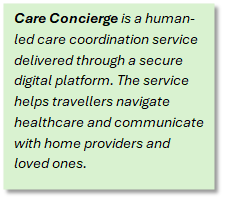
Care Concierge is designed to fill this gap by focusing on people, not just incidents. Its defining characteristic is a proactive approach to care, helping travellers anticipate and manage issues before they escalate into emergencies.
A Care Concierge model provides a consistent human point of contact who understands the traveller’s situation from start to finish. Rather than navigating multiple handoffs alone, the traveller has someone who holds context, tracks progress, and ensures follow-through across the full journey.
Proactive support can begin well before travel. Travellers may receive guidance on preparation, such as recommended vaccinations, documentation, or planning considerations for pre-existing conditions. During travel, concierge support can extend to early identification of potential concerns, informed by traveller-reported data or connected health devices, as well as practical tools and guidance to manage common stressors such as jet lag, fatigue, and travel-related anxiety.
Care Concierge can also support travellers when mental health needs arise, offering guidance and connection to appropriate resources when stress, anxiety, or emotional strain becomes part of the travel experience. In unfamiliar environments, this type of support can be as important as physical care.
Language and cultural barriers are another common source of stress during healthcare events abroad. Care Concierge can help bridge these gaps by supporting communication with local providers, including access to translation services where needed, helping travellers better understand their care and next steps.
After the trip, support can continue through recovery and follow-up, such as managing diet after illness, addressing skin or health concerns related to sun exposure, or coordinating next steps with providers at home.
Importantly, Care Concierge does not replace insurance or assistance. It brings these services together, aligning providers, assistance teams, insurers, and family members around the traveller’s care journey.
Care Concierge is delivered through a secure digital platform that allows travellers to access care coordination virtually via desktop, tablet, or mobile. The platform supports communication, documentation, and continuity across the care journey, while keeping human care coordinators at the centre of the experience. Technology enables scale and timely access without replacing the human relationship.
Premium travel today is increasingly defined by continuity, care, and low stress, high touch support, particularly when healthcare needs arise far from home. As expectations rise, insurers have an opportunity to evolve what premium coverage truly delivers, not by replacing existing models but by strengthening them in ways that reflect how travellers actually experience care.
For insurers evaluating their premium travel offerings, the following considerations are becoming increasingly important:
For forward-thinking insurers, integrating Care Concierge for Travel is both a practical and strategic response to how premium travel is evolving. Whether embedded within a policy or offered as a complementary service, it reflects what travellers increasingly expect when healthcare becomes part of the journey.
Follow us on Social Media!